
Structured for maximum impact field-driven achievements
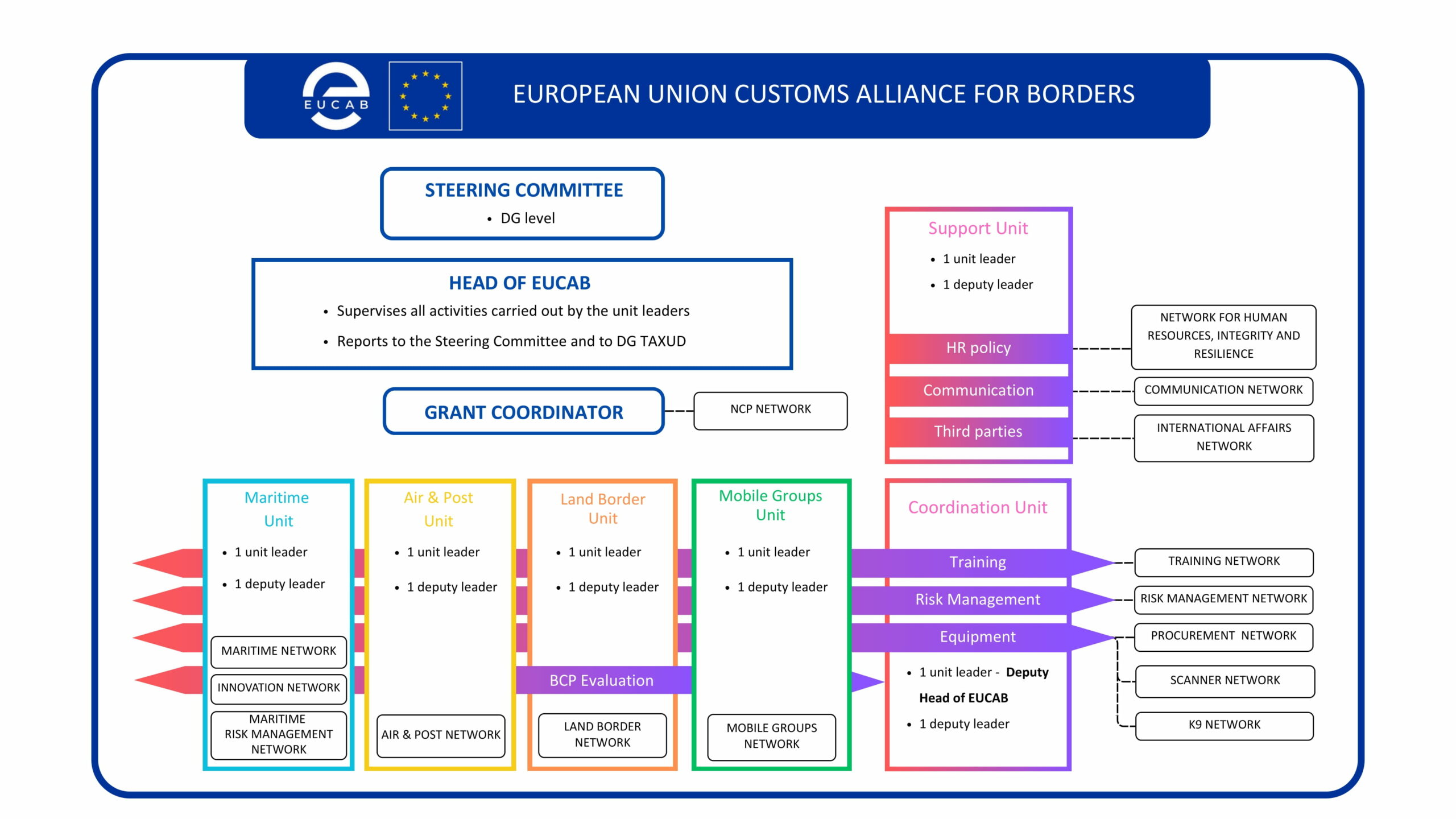
Layer 1 - The Steering Committe
Layer 2 - The Management Board (Head of EUCAB, Unit Leaders, Deputy Unit Leaders and Grant Coordinator)
Layer 3 - EUCAB Units
Layer 4 - EUCAB Networks (including experts) from participating Member States
Layer 1 - The Steering Committee
The members of the Steering Committee are Heads of customs administrations of all Member States, or their Deputies/appointed representatives.
Representatives of the European Commission (DG TAXUD), the Head of EUCAB and the Grant coordinator are non-voting participants in the Steering Committee.
The Steering Committee is chaired by the Member State holding the Presidency of the Council of the European Union.
Members share experience, best practices and information on emerging risks and operational, financial, and compliance challenges.
The Steering Committee:
- monitors and reviews developments and outcomes of EUCAB’s activities, in line with the Implementation Plan;
- proposes to Member States adjustments of the latter’s implementation, in coordination with the DG TAXUD;
- discusses and decides on strategic and implementation issues, provides policy advice and guidelines on the functioning of the expert team and the operation of the projects.
Layer 2 - The Management Board

The Head of EUCAB is responsible for the overall project planning, coordination, and execution of the project, including strategic issues, communication and dissemination of results, engagement with partners and stakeholders.
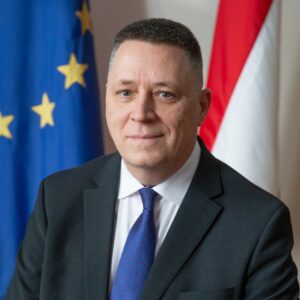
Martin Reuter is EUCAB’s main interface with the DG TAXUD and the Steering Committee.
He is supported by EUCAB’s Deputy Head, the Grand coordinator, the Unit Leaders and their deputies.

Layer 3 - Six working units
EUCAB is organized into four operational units and two horizontal units, each with a specific mission but with closely interlinked activities.
All units are formed by a Unit Leader, a Deputy Leader and about ten experts.
Unit Leaders, supported by Deputy Unit Leaders, manage specific areas of responsibilities assigned to their corresponding units by the Implementation Plan. They program, oversee and follow their units’ activities.
Four operational units
Air & Post Unit
The unit’s mission is to enhance the protection of the internal market through effective customs control activities in passenger, cargo, express courier, and postal operations.
It tackles major issues related to the flow of goods and passengers in connection with customs work at airports. It devises solutions to challenges raised by the increase in e-commerce and air freight flows. It supports diagnostics in airport and postal facilities, develops specific risk indicators for express couriers and small consignments, and tests operational solutions through targeted joint activities. Taking into account the existing Member States’ capacities, it strengthens collaboration among EU Member states’ customs administrations in priority areas such as risk analysis, control methods, training and equipment recommendations.
- Air & Post Unit Leader: Xavier Pascual
- Air & Post Deputy Unit Leader: Tiziana Robustelli
Land Border Unit
The unit’s mission is to ensure high-quality customs control at EU’s external land (road and rail) border crossing points (BCPs).
It focuses on operational performance and enforcement capacity, balancing the need to fight illicit trade (detecting illegal activities, enforcing prohibitions and restrictions,) with the aim to ensure efficient border flow (reducing waiting times, facilitating VAT refund procedures). It runs diagnostics and threat assessments, and facilitates coordination of control efforts focusing on important areas such as trafficking in excise goods, undeclared cash, weapons and dual-use goods, drugs and drug precursors. It supports customs controls on the ground by favouring cooperation and insights, in particular through Joint Control Activities (JCAs).
- The Land Border Unit Leader: Mika Poutiainen
- The Land Border Deputy Unit Leader: Peychin Ivanov
Maritime Unit
The unit’s mission is to ensure that customs administrations act more efficiently and effectively to improve control activities, identify threats, thus raising resilience of EU ports and the maritime sector (logistics, information, staff).
It focuses on the operational coordination of customs work in seaports and inland ports to achieve a level playing field in terms of security and safety between EU ports. It also covers trade facilitation in this environment. The priorities are on building up networks, sharing experiences and best practices, improving trends assessment and solution building in response to vulnerabilities identified.
- The Maritime Unit Leader: Jeroen Engelberts
- The Maritime Deputy Unit Leader: Nicolas Chiellino
Mobile Customs Unit
The unit’s mission is to identify critical areas and common issues on inland mobile controls.
It focuses on promoting exchange of information and sharing of best control practices in this field. It assists Member States’ customs administrations in developing mobile equipment and promotes synergies between customs controls on the road and at fixed border crossing points.
- The Mobile Customs Unit Leader: George Nikolaidis
- The Mobile Customs Deputy Unit Leader: Robert Szewczyk
Two horizontal units
Coordination Unit
The unit’s mission is to coordinate overarching expertise and activities of the expert team, thus ensuring conditions for effective collaboration, consistency and performance across all areas of the project.
It focuses on conducting training, procuring and analyzing control equipment, and improving and intensifying cooperation in risk management. It works closely with the operational units to optimize efforts, eliminate overlaps, reduce duplication, ensuring that all members of the expert team move forward in synergy.
- The Coordination Unit Leader: András Bartha
- The Coordination Deputy Unit Leader: Lauris Krivans
Support Unit
The unit’s mission is to ensure the operational coherence of the expert team by providing all necessary cross-cutting services that foster cooperation inside EUCAB, with partners and third parties.
It focuses on priority areas of external communication and visibility, human resources, resilience, and integrity. It plays a central role in coordinating collaboration with third parties and international organizations.
- The Support Unit Leader: Agnieszka Butrym-Bielatko
- The Support Deputy Unit Leader: Maria Prieto
Layer 4 - Thirteen Expert Networks
To extend Member States’ participation, strengthen horizontal collaboration, and enhance topic-specific expertise, EUCAB established and manages 13 thematic networks.
They are formed by national experts appointed by Member States’ customs administrations, and coordinated by a lead expert from EUCAB.
They play a major role in promoting shared priorities and strengthening capacities within the customs community.
EUCAB’s networks cover operational fields and strategic support areas:
- Air & Post Network
- Land Border Network
- Maritime Network
- Mobile Groups Network
- Risk Management Network
- Scanner Network
- K9 Network
- Procurement Network
- Training Network
- Innovation Network
- Human Resources (Resilience & Integrity) Network
- International Affairs Network
- Communication Network